
Adeline Smith, Museum Director
304-273-1999
museum@cityofravenswood.com
Located in Washington's Riverfront Park
Open Tuesday-Saturday 12pm-4pm
Hello from the Great Bend Museum in Ravenswood! We were founded in 1972 by the Jackson County Historical Society to share the history of our county and the Ohio River’s Great Bend region through objects, photographs, and archives. In 2020, the Historical Society entrusted the museum and its collection to the City of Ravenswood, ensuring that we can continue preserving and promoting county history for generations to come.
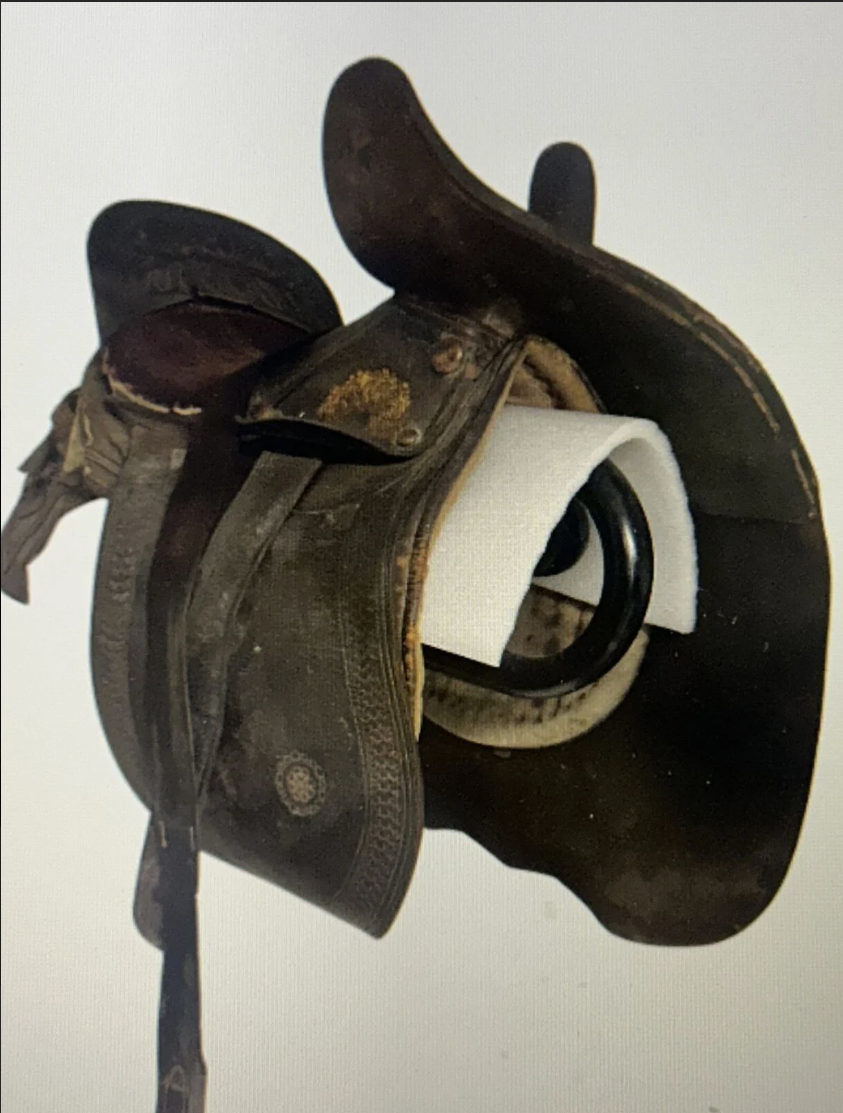
Object Stories: The side saddle pictured at right features decorative embossing along its leather edges, a green stripe, and a cloth-lined underside accented with a heart-shaped leather detail embossed with floral designs. It belonged to Minnie McBride, the first female postmistress in Sherman, West Virginia. Minnie relied on this saddle as she traveled mile after mile along her mail route, delivering letters and connecting households at a time when postal work demanded both physical endurance and independence.
Today, the saddle’s leather is affected by red rot, a form of deterioration that causes it to become powdery and fragile over time. While red rot cannot be reversed, careful storage and minimal handling can slow its progression. Because of its condition, the saddle is not currently on display but preserved in controlled storage. Even off view, it remains an important record of women’s labor, mobility, and everyday life in rural West Virginia.
Just Around the Corner: On Feb. 21 at 1 p.m., the museum invites the community to Captured in Crisis, a free program exploring one of the most devastating natural disasters in Ohio Valley history. In 1937, floodwaters submerged much of Ravenswood, reshaping the town and the lives of those who lived through it.
As the water rose, photographer Clara Weisheit ventured out by boat, documenting the destruction as it unfolded. Her images remain some of the most powerful visual records of the flood, capturing not only the scale of the disaster but also the resilience of a community facing unimaginable loss.
This program will be held at the Jackson County Library in Ripley and is open to all. We hope you’ll join us as we reflect on this pivotal moment in local history and the essential role photography plays in preserving memory.
Director’s Desk: This month marks the first time our featured object isn’t currently on display at the museum. That choice may feel unexpected, and truthfully, I had my own reservations; however, it reflects a question nearly every museum visitor asks at some point: What isn’t on display? Beyond the galleries and cases, past the doors that are designated for staff only, there is a quiet curiosity about what isn’t being shown and why.
I felt that same curiosity long before I ever worked in a museum.
My grandmother was a docent at the Campus Martius Museum, and as a child, I spent countless hours wandering through its galleries. While I loved the exhibits, I was just as fascinated by the spaces visitors weren’t meant to see. Watching staff disappear into back rooms sparked my imagination. What stories were stored there? What objects were waiting for their turn?
That curiosity is ultimately what drew me into the museum field. Museums are places where asking questions is not only encouraged but essential. Over time, I learned that what we choose to display, and rather what we don’t, is never accidental. In most museums, only a small portion of the collection is on view at any given time. The rest is carefully stored, not because it is less meaningful, but because responsible stewardship requires thoughtful decisions about care, context, and longevity.
Preservation plays a major role in those decisions. Light exposure can cause fading and weakening in paper, textiles, photographs, and painted surfaces. Changes in temperature and humidity can lead to cracking, warping, or mold growth. Some objects are simply too fragile to withstand long periods on display without risking permanent damage.
Interpretation matters, too. Not every object tells its story well on its own. Some require additional research, comparison, or planning before they can be responsibly presented to the public. In those cases, storage allows time for careful study rather than rushed storytelling.
So this month, I just wanted to take the time to encourage you to be curious and to wonder about what isn’t on view. Much of our collection is preserved behind the scenes, where its histories continue to be studied and documented. I invite you to explore our full catalog on the City of Ravenswood’s website, where you can find stories that extend beyond the gallery walls. There, some of the most interesting objects and stories from our community are simply waiting to be discovered.
The Great Bend Museum, 220 Riverfront Park in Ravenswood, is open Tuesday through Saturday from 12 p.m. to 4 p.m. Follow on Facebook, visit www.cityofravenswood.com/museum, call 304-273-1999, or email us at museum@cityofravenswood.com.


Adeline Smith, Museum Director
304-273-1999
museum@cityofravenswood.com
Located in Washington's Riverfront Park
Open Tuesday-Saturday 12pm-4pm

