
Adeline Smith, Museum Director
304-273-1999
museum@cityofravenswood.com
Located in Washington's Riverfront Park
Open Tuesday-Saturday 12pm-4pm
Hello from the Great Bend Museum in Ravenswood! We were founded in 1972 by the Jackson County Historical Society to share the history of our county and the Ohio River’s Great Bend region through objects, photographs, and archives. In 2020, the Historical Society entrusted the museum and its collection to the City of Ravenswood, ensuring that we can continue preserving and promoting county history for generations to come.
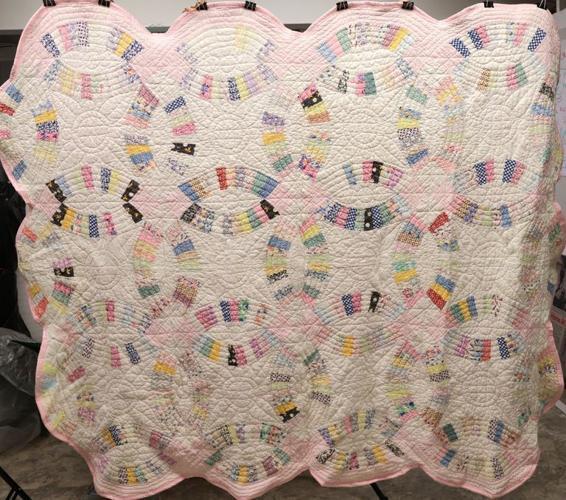
Object Stories: The quilt pictured at right features the interlocking arcs of the Double Wedding Ring pattern, formed from carefully pieced curved segments that create overlapping circles across a light background. Each ring is composed of small fabric scraps, florals, dots, stripes, and soft pastels arranged in a balanced but varied design. Fine quilting stitches add texture and secure the layers together.
The Double Wedding Ring pattern rose to popularity in the late 1920s and 1930s and was often associated with marriage and unity. Its design made it especially meaningful as a wedding gift while also allowing quiltmakers to use small leftover fabric pieces. Piecing curved seams required patience and skill, reflecting the time and care invested in its construction.
Now preserved at the museum, this quilt represents more than decorative needlework. It reflects domestic craftsmanship, resourcefulness, and the ways families marked significant moments in their lives through handmade objects.
Just Around the Corner: At 1 p.m. Feb. 28, we invite the community to join us at the Ripley Library for Captured in Crisis, a program exploring one of the most devastating natural disasters in Ohio Valley history.
In 1937, floodwaters submerged much of Ravenswood, reshaping the town and the lives of those who experienced it. Amid the rising waters, photographer Clara Weisheit ventured out by boat, documenting the destruction as it unfolded. Her images remain among the most important visual records of the flood, capturing not only the scale of the disaster but also the resilience of the community in its aftermath.
This program will take a closer look at those photographs and the stories they preserve. We hope you will join us as we reflect on this pivotal moment in local history and the role visual documentation plays in shaping how we remember it.
Director’s Desk: With Valentine’s Day approaching, we often think about the ways we express care, whether it be through cards, flowers, or thoughtful gestures. This year, that felt like the right lens for selecting our Object of the Month: A handmade textile that reminds us that love is not always measured in purchases, but in hours spent stitching.
There is something meaningful about creating something by hand for another person. It requires time, patience, and intention, qualities that cannot be rushed. In our collection, we see that generosity is preserved in quilts, shawls, and clothes. Handmade textiles remind us that care is often quiet. The hours invested in each stitch reflect a commitment that extends beyond decoration; they reflect presence.
That is often how handmade textiles function. They are practical objects, but they also carry intention because they hold both material and emotional value; thoughtful preservation matters.
Whether you plan to display or store a family quilt or garment, preservation begins with stability. Light is one of the greatest threats to fabric. Prolonged exposure to sunlight or even strong indoor lighting can cause fading and fiber breakdown. If you choose to display a textile in your home, avoid direct sunlight and consider rotating it periodically rather than keeping it continuously on view. Hanging a quilt for years at a time can place stress on fibers, particularly along the top edge.
Temperature and humidity also play an important role. Attics and basements are rarely ideal storage spaces. Heat accelerates deterioration, and damp environments invite mold and pests. A stable, climate-controlled interior closet is often far safer than a garage or cedar chest.
When storing textiles, avoid plastic containers that trap moisture. Acid-free boxes are best, but if those are not available, clean, unbleached cotton sheets can be used to wrap items safely. Avoid newspaper, colored tissue, or cardboard, which can transfer acids and cause staining over time. If folding is necessary, pad creases with cotton or acid-free tissue and refold occasionally along different lines to prevent permanent stress.
Finally, preserve the story alongside the fabric. Write down who made it, when it was given, and why it mattered. Textiles can endure for generations, but context is often more fragile.
At the museum, we are entrusted with preserving the handmade pieces of our shared history. In many homes, similar pieces rest quietly in closets and cedar chests. With thoughtful care, those stitched expressions of affection can continue to speak long after the season has passed.
The Great Bend Museum, 220 Riverfront Park in Ravenswood, is open Tuesday through Saturday from 12 p.m. to 4 p.m. Follow on Facebook, visit www.cityofravenswood.com/museum, call 304-273-1999, or email us at museum@cityofravenswood.com.


Adeline Smith, Museum Director
304-273-1999
museum@cityofravenswood.com
Located in Washington's Riverfront Park
Open Tuesday-Saturday 12pm-4pm

